
The Coastal Road is open. The metro is closer to operational than at any point in the last decade. The supply pipeline of new launches is the thinnest it has been in a decade. And the buyer pool — South Mumbai-rooted families, returning NRIs, BKC executives — has only deepened. Is Worli a good investment in 2026? Here is the comprehensive analysis, with the structural drivers, historical performance, forecast outlook, and the buyer-profile framework that decides whether Worli works for your specific case.
30–45%
5-yr appreciation
5–8%
Forecast 26–30 p.a.
2024
Coastal Road open
Near-term
Metro opening
2.0–2.5%
Rental yield
7–15 yr
Right horizon
The structural case — four pillars
Worli’s investment thesis rests on four structural factors, all of which strengthened in 2025 – 2026:
- Supply scarcity — Worli has a small residential footprint. New launches are concentrated in adjacent micro-markets (Lower Parel, Prabhadevi, Mahalaxmi), not in Worli itself.
- Demand depth — three buyer pools (end-users, NRIs, executives) consistently support transaction volumes regardless of broader market cycles.
- Infrastructure — Coastal Road operational; metro coming; sea-face promenade upgraded; commute times to BKC, Marine Drive, and Nariman Point all reduced.
- Defensibility — through the 2020 – 2021 broader slowdown, Worli held value better than most South Mumbai sub-localities. The pattern repeated through earlier cycles.
“Worli is not the cheapest market in Mumbai, but it is one of the most defensible. Cycles affect it less than most South Mumbai sub-markets, and the structural drivers compound.”
Coastal Road — the 2024 game-changer
The Mumbai Coastal Road — operational on the southbound stretch since March 2024 — has materially altered Worli’s commute equation. What was previously a 30 – 45 minute drive to Marine Drive in peak traffic is now reliably 12 – 18 minutes. The northbound stretch is in advanced commissioning.
This has three measurable effects on Worli property values:
- Worli becomes more attractive to South Bombay-rooted buyers (Cuffe Parade, Walkeshwar) seeking newer inventory.
- Office workers based at Nariman Point gain a Worli residence as a viable option without giving up commute predictability.
- The seafront promenade upgrade increases lifestyle appeal — Worli Sea Face stretches benefit most.
Metro connectivity — the next leg
The Worli metro station, part of Mumbai Metro Line 3 (Aqua Line), gives Worli direct rail connectivity to BKC and the Andheri-Powai corridor. When fully operational, it will:
- Reduce BKC commute to ~25 minutes (from current 35 – 50 minutes).
- Enable BKC-based executives to live in Worli with predictable commutes.
- Drive a structural rental yield uplift — the typical post-metro impact in Mumbai sub-markets has been 30 – 50 basis points within 18 months of operation.
- Strengthen rental demand for studios and 1 BHK inventory aimed at solo professionals.
Capital appreciation trends — historical and forecast
Worli’s historical and forecast performance:
| Period | Appreciation | Driver |
|---|---|---|
| 2011 – 2016 | 10 – 18% | Pre-RERA cycle, mill land redevelopment |
| 2016 – 2021 | 5 – 12% | RERA implementation, demonetisation, slow market |
| 2021 – 2026 | 30 – 45% | Coastal Road, supply tightening, NRI/HNI demand |
| 2026 – 2030 (forecast) | 5 – 8% p.a. | Metro completion, supply scarcity, end-user demand |
| 2030+ (long-term) | 4 – 7% p.a. | Mature market; trophy inventory premium continues |
Sea-view premium inventory may outperform; inner-spine projects will track the broader average. Sub-localities further from the seafront will track or slightly underperform the average. For deeper rate analysis, see our complete 2026 Worli property rates breakdown.
Rental yield reality check
Worli’s gross rental yield in 2026 is approximately 2.0 – 2.5% — at the lower end of South Mumbai. This is a structural feature of high capital values; yield in Worli has historically been compensated by appreciation. Yield-focused investors are better served by Lower Parel (3.0 – 3.5% yield).
Risks to consider — the honest list
The Worli case is not without risks:
- Concentration risk — for investors with most of their net worth in one Worli flat, this is a portfolio risk.
- Liquidity — premium inventory has a deep buyer pool, but resale timelines are typically 60 – 120 days. Not a quick exit.
- Cycle risk — like all Mumbai property, Worli is correlated to broader real estate cycles. Patience matters.
- Maintenance and society dynamics — older buildings have higher maintenance and slower decision-making.
- Tax changes — capital gains and stamp duty regimes are politically sensitive and can change.
- Climate / sea-rise risk — long-term consideration for sea-facing inventory; managed by buildings via foundation engineering.
Who is Worli right for?
- End-users with 7 – 15 year horizons who value seafront, schools, hospitals.
- Returning NRIs seeking a recognised, defensible South Mumbai address.
- HNI investors looking for trophy inventory with long-term defensibility.
- Executives at Lower Parel, BKC, Worli or Mahalaxmi who want short, predictable commutes.
- Families committed to specific schools (Bombay Scottish, Da Silva, Cathedral).
Who Worli is not right for
- Short-term flippers with 1 – 3 year horizons (better returns in suburbs).
- Pure yield investors (Lower Parel offers 50 – 100 bps higher yield).
- Buyers with most net worth concentrated already in Mumbai property.
- Those seeking rapid liquidity (60 – 120 day resale window is too long).
The decision framework
Three questions to answer before buying in Worli for investment purposes:
- Horizon — Can you commit 7+ years? If not, Worli appreciation is harder to capture.
- Profile fit — Are you end-user / NRI / HNI / yield-balanced? If pure yield, look at Lower Parel instead.
- Concentration — Will this Worli buy be more than 30% of your net worth? If yes, diversification matters more.
Key Takeaways
- Worli is a defensible long-cycle investment market — supply-constrained, infrastructure-supported, demand-deep.
- Forecast appreciation 5 – 8% p.a. nominal through 2030; sea-view inventory may outperform.
- Rental yield 2.0 – 2.5% — supplemented by appreciation, not replaced by it.
- Coastal Road and upcoming metro are the two biggest infrastructure tailwinds.
- Right for end-users, NRIs, HNI, executives with 7+ year horizons.
- Wrong for short-term flippers and pure yield investors — Lower Parel is better for the latter.
Final thought
Worli in 2026 is a defensible, long-cycle investment market — not a quick-flip play. For buyers with the right horizon and profile, the structural case is as strong as it has been in a decade. The compounding of supply scarcity, infrastructure tailwinds, and demand depth supports the price floor. Forecast appreciation is steady rather than spectacular, and comes with the defensibility that has held through every Mumbai property cycle.
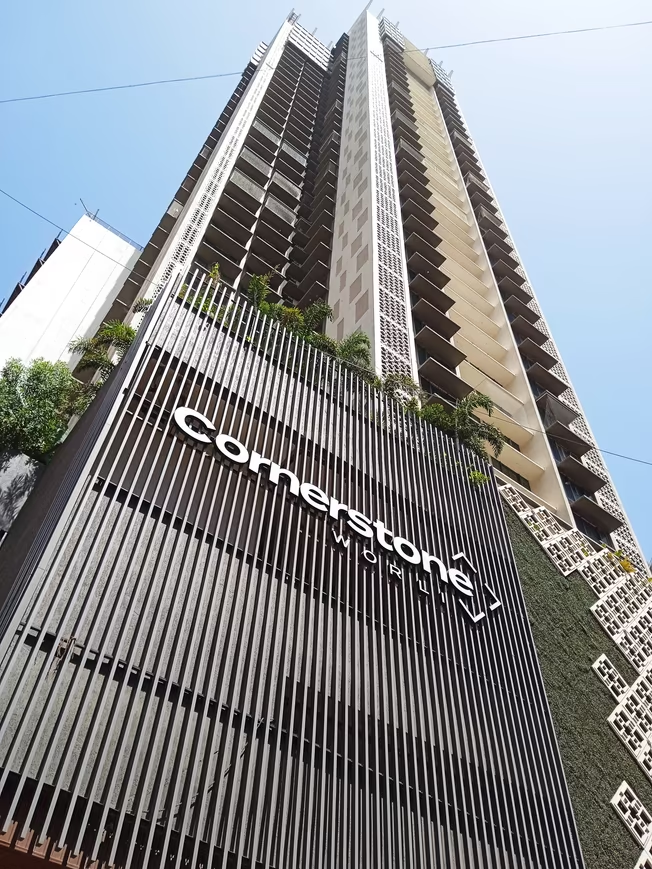
To explore specific inventory at Cornerstone Worli, see our Buyer page, the floor plans and curated buyer & resident perspectives. For a comparative view against neighbouring micro-markets, Worli vs Lower Parel vs Prabhadevi. For the wider buying process, our complete buyer’s guide.